French Army
An Officer and a SpyThe French Army gives Georges Picquart his education, identity, and measure of achievement, but it also becomes the institution he must challenge when its leaders protect a wrongful conviction. In the novel, the army’s traditions of discipline and service coexist with intelligence work conducted in secrecy and a chain of command that can make institutional loyalty outweigh the search for truth. Picquart’s effort to identify the real spy exposes that contradiction: the army treats the case not only as a question of guilt, but as a threat to its authority and reputation.
Vocation, discipline, and public service
Picquart describes his career as a consequence of the 1870 defeat: after that humiliation, he regarded a life outside the army as frivolous. The Ministry of War paid for his education, and he came to experience the army as a demanding paternal authority. He compensated for what he calls his dreamy, artistic temperament through severe discipline. At Saint-Cyr he finished fifth in a class of 304 cadets; he learned German, Italian, English, and Spanish, served in the Aurès mountains in North Africa and on the Red River in Indochina, and received the Colonial Medal, a bravery star, and the Legion of Honour. After twenty-four years in uniform, he was commended by both the Minister of War and the Chief of the General Staff. These accomplishments explain why betraying the army feels to him like a betrayal of his deepest attachment, not merely a break with an employer.
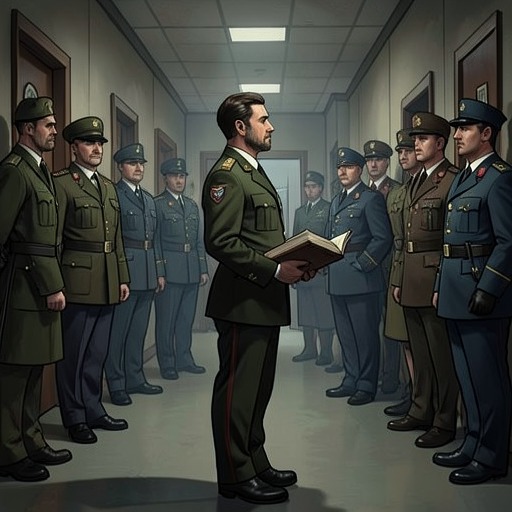
That attachment is visible in the army’s public ceremonies as well as Picquart’s private account of his career. When Alfred Dreyfus’s degradation is staged at the École Militaire, Picquart leaves the crowd’s route to the official assembly point and enters the institution where he had taught topography until the previous year. The Paris regiments have been ordered to send two companies apiece: one of experienced soldiers, the other of recruits whom Auguste Mercier believes will gain moral strength from witnessing the ceremony. The military setting makes the spectacle an act of instruction as well as punishment. Years later, Picquart returns to the same parade ground in the uniform of a brigadier general for Dreyfus’s medal ceremony, a reversal that joins public recognition to the earlier scene of disgrace.
Intelligence work and the Dreyfus case
The army’s intelligence mission is presented as a modern front line, and Picquart initially treats it as a legitimate extension of military service. He argues that espionage offers an opportunity to push that front line into German territory, in keeping with the army’s traditions. His discovery of Ferdinand Walsin Esterhazy gives that belief a concrete target. Picquart concludes that Esterhazy is selling French secrets to a foreign power, while continuing a life of gambling and conspicuous spending. The discovery changes the meaning of the original case: the officer convicted of treason is not, in Picquart’s assessment, the source of the betrayal.
The army’s first prosecution of Dreyfus rests on a coordinated account from officers and intelligence personnel. At the 1894 court-martial, a single question asks whether Dreyfus, a captain of the 14th Artillery Regiment and a probationer on the General Staff, delivered confidential national-defence documents to a foreign power or its agents in Paris. The verdict is delivered in public after the court has met in camera. At the later inquiry described by Picquart, six key witnesses help sustain the case: Charles-Arthur Gonse explains how Dreyfus could have accessed the documents in the bordereau; Judge Fabre and d’Aboville describe his supposed suspicious conduct; Hubert-Joseph Henry insists that the bordereau came from the German Embassy; Felix Gribelin uses police reports compiled by Guénée to depict Dreyfus as a gambler and womanizer; and Armand du Paty de Clam attributes degrading motives to him despite his restrained appearance. Dreyfus shakes his head at du Paty’s allegations. The differing testimony gives the case an institutional appearance of breadth, while Picquart finds parts of its supporting portrait unbelievable.
The procedures surrounding the trials also determine what can be examined. At one hearing, prosecutor Brisset requests a private session because of the case’s sensitive nature. At the later military inquiry, the prosecution’s appeal to secrecy helps restrict public scrutiny. During the Rennes trial, Mercier instead introduces documents from the secret dossier into open court, including the letter he continues to interpret as referring to Dreyfus and fabricated Guénée reports. Picquart recognizes that this disclosure gives the defence an opportunity to challenge the material. Across these proceedings, secrecy is not a fixed rule used in only one direction: it can keep evidence from public examination or, when the prosecution displays it, expose weaknesses to questioning.
Command, information control, and suppression
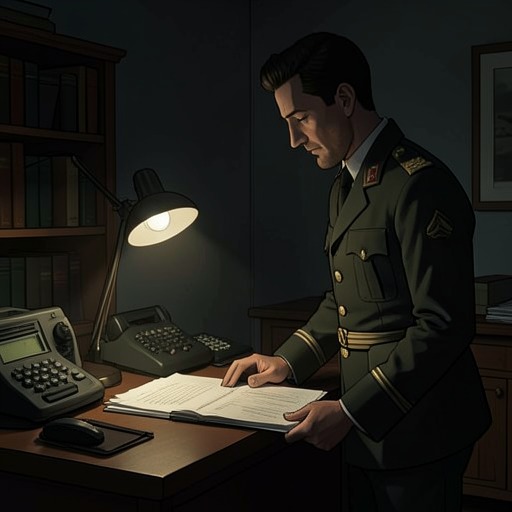
Picquart first presents the evidence of his Esterhazy investigation to Raoul le Mouton de Boisdeffre and then to Charles-Arthur Gonse, the Chief of Intelligence. Among the materials are the petit bleu, surveillance photographs, and the secret file. He softens the significance of the petit bleu by pretending that it arrived later than it did, but Gonse studies the papers methodically and appears untroubled, even when cigarette ash falls on the photographs. His composure contrasts with the importance Picquart assigns to the evidence. Gonse’s instruction to forget the bordereau makes the institutional priority plain: the discovery is not to reopen the original case.
In private, Gonse acknowledges that the investigation of Dreyfus was not handled as professionally as it should have been and recognizes faults in the work of Jean Sandherr and du Paty. Yet he argues that the army cannot go back over the case because doing so would reopen wounds and risk national division. He appeals to the public agitation around Dreyfus and suggests that Picquart should not care if a Jewish man remains on Devil’s Island. This is not simply a request for discretion: it turns the prisoner’s Jewish identity into a reason to discount the consequences of the conviction. Gonse then formalizes the demand. He orders Picquart to stop investigating anything connected with the case and forbids disclosure to anyone not authorized to receive the information, invoking the command chain from Minister of War to Chief of Staff to himself and then to Picquart.
The same control of information appears in administrative decisions. As Picquart prepares to leave on an inspection tour, Gonse arranges for Major Henry to bring all the Agent Auguste material directly to him. The change removes a stream of intelligence from Picquart’s handling. Picquart later assesses the danger as wider than any one officer: the Minister of War, the Chief of the General Staff, the Head of Military Intelligence, and the commander of the 4th Army Corps are implicated to varying degrees, as is the secret intelligence section. He does not claim that every officer is corrupt; he recognizes that there are honourable men in senior positions. His concern is that, when the choice arises, those officers will protect the army’s interests rather than bring its failures into the open.
Picquart’s account of the military inquiry describes how the army’s investigative authority can be turned against a witness who challenges its conclusion. He tells the investigators that Boisdeffre and Jean-Baptiste Billot initially supported his inquiry, then changed their positions once its implications for the Dreyfus case became clear. He recounts his exile to Tunisia and the General Staff’s attempt to send him on a dangerous mission, and says that forgeries and false testimony are being used to frame him as Dreyfus was framed. His concern is sharpened by the prospect that Henry and Gonse can supply further supposed proof to a loyal inquiry led by Georges de Pellieux. The institution Picquart once served as the source of his honour now controls the evidence, the investigators, and the channels through which he can defend himself.
Public trials, punishment, and restoration
At the Rennes trial, the French Army’s defence of its earlier judgment is made physically visible in a crowded courtroom. Several hundred people fill a hall with a stage, seven crimson-backed chairs, the desks of prosecution and defence, crowded press benches, and members of the public behind a line of infantry. Among the witnesses are Boisdeffre, Gonse, Billot, Pellieux, Jules-Maximillien Lauth, and Gribelin; they carefully avoid one another’s gaze. The arrangement places senior officers together as witnesses while the press and public watch the proceedings. When the harsh conditions of Dreyfus’s confinement on Devil’s Island are described, even Boisdeffre and Gonse appear embarrassed. Dreyfus says he will defend his honour and that of his children, but will not speak of the treatment he has endured. Picquart understands this silence not as indifference but as a refusal to be reduced to victimhood, and respects him for it.
The army nevertheless emerges from the proceedings with its public authority intact. After the verdict against Dreyfus, Picquart’s brother officers applaud and cheer for the army and France; some voices turn to antisemitic abuse and insults against Dreyfus, Mathieu Dreyfus, and Picquart. Picquart believes the result was predetermined, yet the outcome still leaves him stunned. He sees Dreyfus as worse off than before, now condemned a second time, and doubts that the army will permit a third hearing. The scene joins institutional solidarity to the public punishment of dissent: the acclaim for the army accompanies a result that deepens the injustice the witnesses and investigators have failed to undo.
Three days after Picquart’s own case reaches its conclusion, the commandant at Mont-Valérien informs him that a panel of senior officers has found him guilty of grave misconduct and dismissed him from the army. Instead of a retired colonel’s full pension, he will receive the pension of a major, thirty francs a week. He is also warned that further public comments about his General Staff service may bring the severest action. The consequence is both professional and financial, and it seeks to silence the account that could expose how the case was managed. With Fernand Labori’s help, Picquart later drafts an open letter to the government and addresses it to Prime Minister Henri Brisson rather than the Minister of War, taking his dispute beyond the military chain of command.
Picquart’s refusal of an offered general amnesty makes clear that restored status is not the same as reconciliation. In December, despite being told that the amnesty would return him to the army and give him a command, he refuses to wear the same uniform as officers he regards as responsible for the affair. Dreyfus, by contrast, is restored to the army as a major and awarded the Legion of Honour. The Chamber of Deputies approves his restoration by 432 votes to 32; a separate motion restores Picquart at the rank he might have attained had he not been dishonourably discharged, passing 449 to 26. Picquart’s return to the École Militaire for Dreyfus’s medal ceremony therefore carries two meanings at once: public restoration for both men, and an unresolved refusal by Picquart to treat the army’s reversal as proof that its earlier conduct has been repaired.